2025 · UI/UX Design
Southwest Airlines
Reimagining the mobile booking experience for a beloved American airline — where warmth, speed, and clarity meet at 30,000 feet.
2025 · UI/UX Design
Reimagining the mobile booking experience for a beloved American airline — where warmth, speed, and clarity meet at 30,000 feet.
Overview
This was a collaborative group project built by a team of four, where my contribution centered on UI/UX and interaction design — shaping how the key screens look, flow, and respond to touch.
Southwest's brand has always been about hospitality, but the mobile booking flow had grown into something that no longer reflected that warmth. I redesigned the core surfaces — fare search, seat selection, check-in, and the post-booking journey — to feel faster, clearer, and friendlier without losing the familiarity loyal passengers rely on.
Background
Before designing for the passenger, I looked at the scale of the industry and what actually earns loyalty within it. Air travel powers a huge share of global tourism — and increasingly, the brands that win are the ones that win on experience.
$9.25 Trillion
Global travel & tourism economic output
World Travel & Tourism Council
11% of Global GDP
Share of worldwide economic activity
330 Million
Jobs supported worldwide by travel & tourism
To lead, you must win at customer experience.
Customers who have a high-quality experience are 2.7× more likely to keep doing business with a brand.
Forrester Research — 2019 Customer Index
Speed is the new expectation.
82% of customers say getting instant responses is important when contacting brands — a clear opening for AI-assisted support.
Source · Business2Community
The Goal
Southwest's ground operations run at a 1:1 staff-to-passenger ratio — every customer interaction requires a dedicated agent. The goal was to cut that in half: one agent handling two passengers simultaneously, without sacrificing the warmth Southwest is known for.
That meant the app needed to be fast enough, clear enough, and confident enough that passengers could self-serve the moments that usually require a human.
1 ground staff per passenger — every interaction requires an agent
1 agent handles 2 passengers — enabled by a smarter self-serve experience
Scope
The full travel journey spans six stages — from first inspiration to sharing photos back home. Rather than redesign everything, this project zooms in on the two moments where friction spikes and a great app matters most: Pre-trip and During trip.
Research
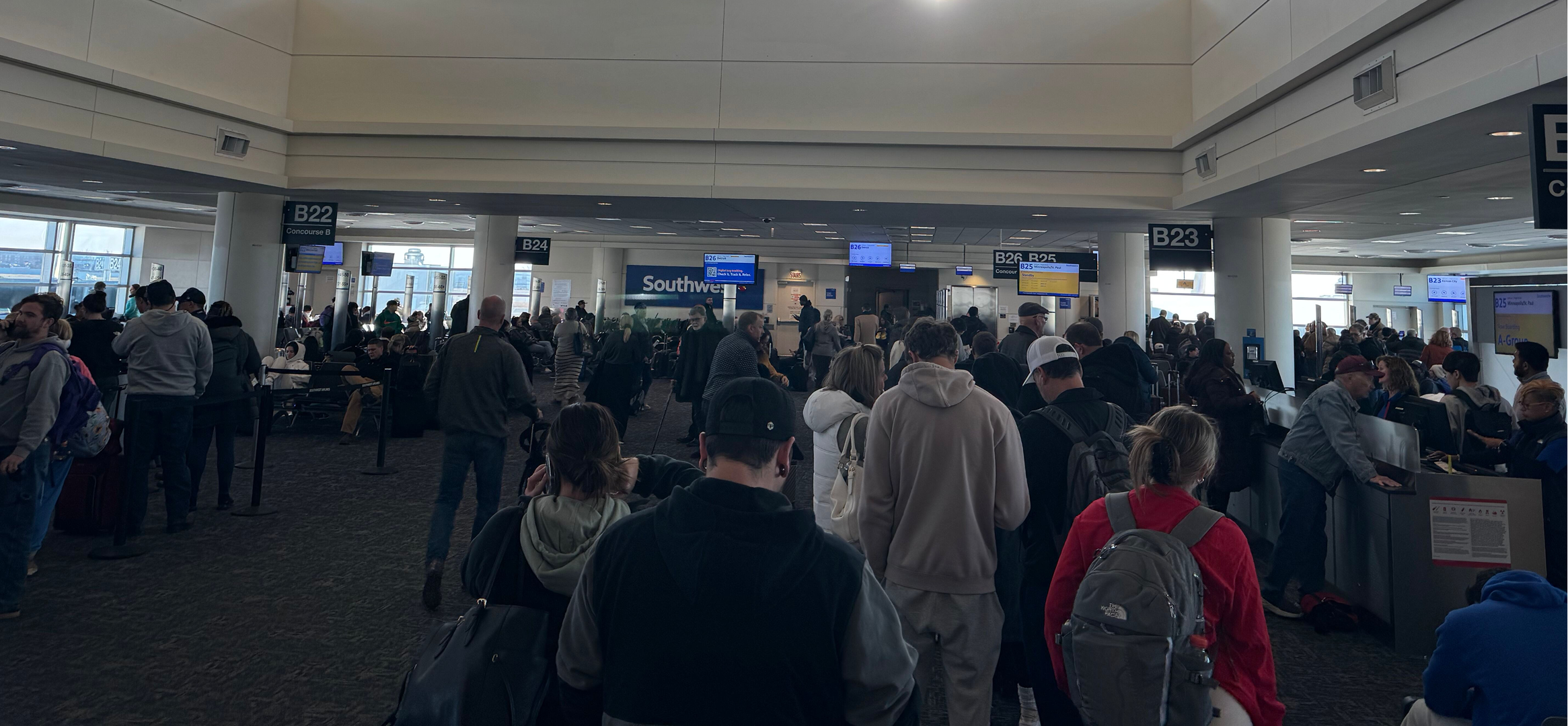
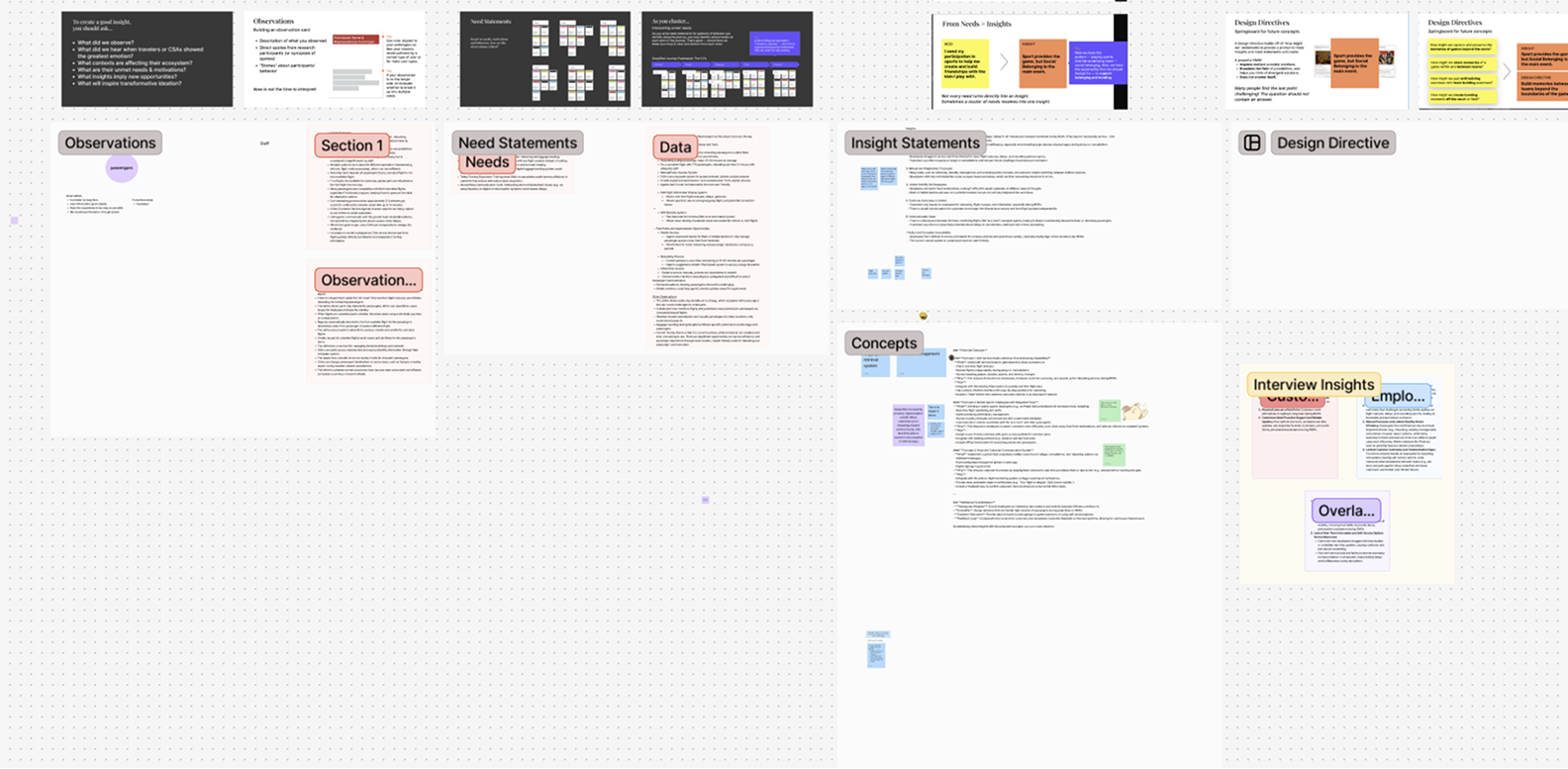
Through direct observation and passenger interviews at Southwest gates, three themes surfaced consistently — each pointing to the same gap between what travelers need during flight disruptions and what the current system provides.
How Might We
How might we increase Customer autonomy and Employee efficiency in our gate areas without sacrificing our award-winning Customer Service experience — especially during IROPs?
Design Tensions
"With how long the line is, there should be more workers at the counter."
"People are already tired… they don't want to wait on line, you know?"
"I wish I could just go ahead and do it on the app."
"If there's a way to get a hotel voucher without waiting in line or talking to somebody…"
Agents write luggage descriptions by hand on paper, then pass the sheet verbally to the ground team — no digital record, no passenger visibility.
Concepts
Each concept targets a distinct pain point from research. Together they form a coherent system that shifts the disruption experience from reactive scrambling to calm, self-directed recovery.
A digital queueing system that gives passengers visibility and control during rebooking, reducing the pressure on gate agents while keeping travelers calm and informed.
A seamless in-app flow to access, manage, and redeem meal vouchers and book nearby hotels — eliminating the counter visit entirely for disrupted passengers.
A CSA-facing tool that replaces handwritten luggage handoffs with a digital capture and relay system — giving the ground team instant, accurate information during IROPs.
Outcome
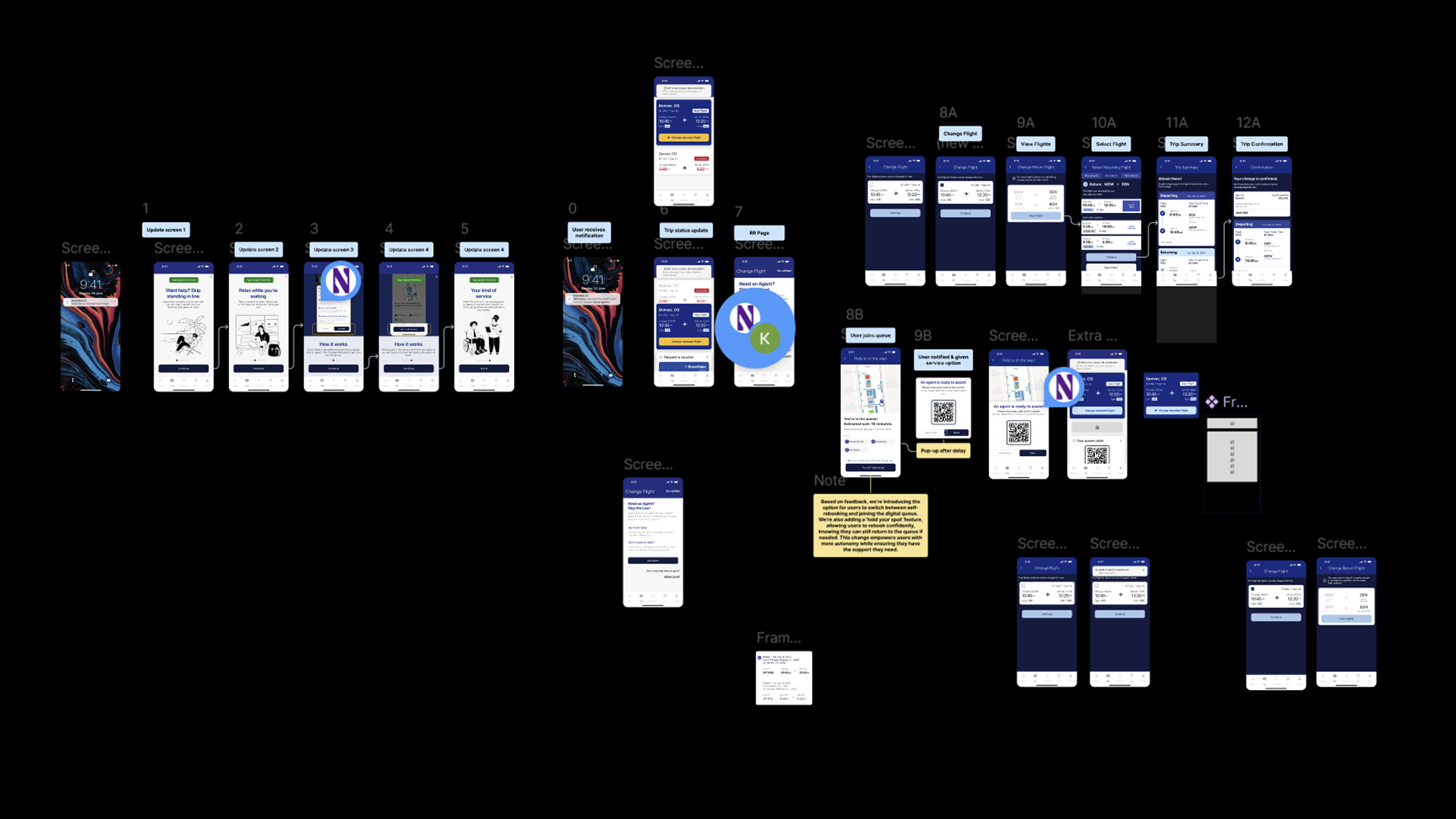
The final designs shifted the disruption experience from reactive scrambling at the gate to proactive, self-directed recovery — giving passengers the information and control they need, the moment they need it.
Users receive a push notification the moment their flight is cancelled — tapping it surfaces everything needed to rebook, claim a voucher, or request help, without ever joining a queue.
Lock screen alert
Instant notification with flight details — no app-hunting required
Instant rebooking view
New flight, gate, and departure time surfaced automatically — one tap to confirm
Agent fallback
"Request an agent" always one tap away for passengers who need extra help
When a flight is cancelled, passengers can rebook themselves in seconds — without waiting in line or speaking to an agent. Flight options, dates, and routes are surfaced automatically, with a clear "Request an agent" escape hatch available at every step for those who need it.
Free flight change, zero queue
Eligible flights surface instantly — passengers confirm a new itinerary with one tap, no counter visit needed
Flexible date & route search
Passengers can change return flights and browse nearby airports for more options — all within the same flow
Agent access at every step
"Request an agent" is always one tap away — autonomy for those who want it, human support for those who need it
When an agent is needed, passengers join a digital queue — no standing, no uncertainty. While waiting, the app surfaces nearby amenities and collects flight preferences upfront, so agents can skip the repetitive intake questions and get straight to resolving the issue.
"I ask each passenger the same set of questions" — CSA Agent
Live wait time + queue position
"You're now in the queue — average wait 15 min" — passengers know exactly where they stand
Airport amenities map
Browse Food & Drinks, Restrooms, and Family areas nearby — reducing stress while waiting
Pre-fill preferences to speed things up
Flight preference (nonstop, same day) and luggage status collected in-app — agents skip intake and go straight to resolving
Value Proposition
The system shifts value across all three stakeholders — passengers feel calmer and more in control, agents focus on what actually requires a human, and Southwest moves closer to its long-term vision of mobile-first operations.
Passenger
CSA Agent
Airline
Roadmap
The solution is designed to scale — from early beta testing with select passengers, to full gate-level integration with digital queue boards visible across the terminal.
Phase 1
Early Adoption
Beta testing with select passengers & airport posters to drive awareness
Phase 2
Feature Development
Supporting digital queue with CSA tablets for seamless agent handoff
Phase 3
Further Integration
Digital queue board displayed at gates — full airport-wide visibility